




A town at the edge of two countries Aflao sits beside Lomé, on a frontier that divides Ghana and Togo but cannot separate the lives that cross it. Traders, families and commuters move between the two cities every day. The border is modern; the…
A town at the edge of two countries
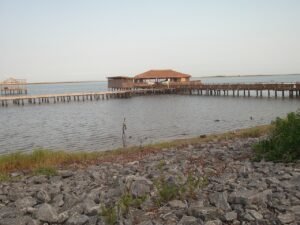
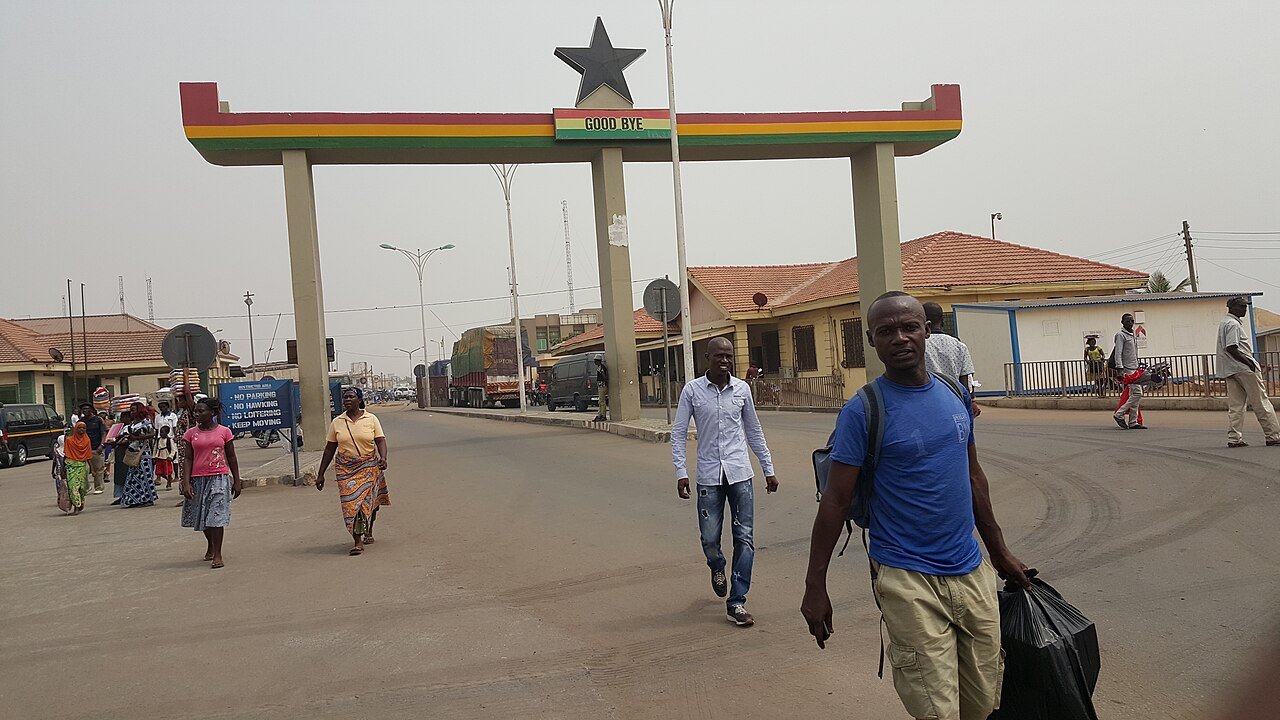
Aflao sits beside Lomé, on a frontier that divides Ghana and Togo but cannot separate the lives that cross it. Traders, families and commuters move between the two cities every day. The border is modern; the communities and routes that shaped this coastal region are older. Aflao’s own origin story remembers arrival, conflict and the decision to make a home in a place already claimed by others.
The account supplied to Ewe Pride gives an older form of the name as Aflawu, or Afla tor wu, interpreted as “Afla’s own has ended” or “what happened at Afla has ended.” Afla is described as a river deity represented by a crocodile. Because spellings and interpretations vary, the name should be checked with Aflao historians and language specialists. The story is valuable as community memory; it is not a verified linguistic record.
The crocodile and the stool
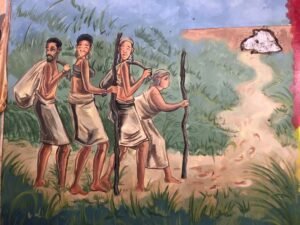
In the account, newcomers arrive as traders and lose their way home. The local chief welcomes them and gives them land, but asks for a first-born son from each family as an offering to Afla. The newcomers accept the demand until one family faces the sacrifice. They decide to resist: a gun is fired at the crocodile deity, and a stool associated with it is taken away.
The story then breaks into a dangerous escape. One ancestor divides the people into groups and remains behind to fight. The others flee across a mysterious stretch of land that, in the telling, swallows some of them. Spiritual power is used to make the land safe for those who remain. The survivors consult their deity and receive the instruction to stay. They bury their religious objects together in a place called Agɔkpanu, described in the account as the royal house. At the end of the ordeal, they declare that the matter of Afla is finished.
The crocodile, the stolen stool and the buried objects make this a story about more than a town’s name. It is also about the obligations newcomers face, the cost of resisting an unjust demand, and how a community seeks spiritual legitimacy for its settlement. The episode involving children should be understood as a feature of the oral narrative. Ewe Pride has found no independent record that such a practice existed as a historical institution.
Aflao and Lomé
Later history gave the area a new kind of frontier. Aflao and Lomé grew into closely connected urban neighbors, even as the colonial boundary placed them under different administrations. Historical research on the two cities describes this “twin city” relationship: trade and social ties cross the border, while differences in law, transport and public services make the border visible in daily life.
The origin story and the modern city belong to different kinds of evidence. The oral tradition explains how Aflao residents remember the land and their ancestors. Urban history traces the growth of Lomé as a trading town and colonial capital. Together, they show how community memory and documented history illuminate different parts of the same place.
A story shaped by the border, not contained by it
Aflao’s story is lived in two directions. It is a Ghanaian border town, but the daily movement of relatives, traders, workers and schoolchildren makes the frontier porous in ordinary life. People cross to visit family, buy goods, work or attend an event; the border also has real consequences, including different currencies, laws, administrations and checkpoints. This present-day setting gives Aflao’s origin story a special resonance: it is a story about a place whose identity has always been shaped by arrival and departure.
The account supplied to Ewe Pride tells of newcomers reaching the area and meeting a crocodile associated with a sacred local authority. In the telling, the visitors are asked to sacrifice a first-born son; a gunshot kills the crocodile, a stool is taken away, and the people divide into groups. One branch crosses the river; another settles at Aflao. A spiritual instruction determines who may remain and receive the land. The account ends with the declaration that the matter is closed: “What happened at Afla has ended.”
The phrase is compelling, but it should not be treated as a verified translation of the town’s name or a documented event. The spelling of the place, the language used in the phrase and the order of episodes need review by Aflao historians and fluent speakers. As a community origin tradition, the story tells readers how newcomers, landholding authority and belonging are remembered. It may carry ideas about consent and obligation: a newcomer cannot simply claim a home; relations with those already there must be negotiated.
That theme is particularly meaningful in a frontier town where belonging can be layered. A family may have kin in both Ghana and Togo; a market route may predate the checkpoint; a person’s language and ancestry may not match the state on the passport. The border itself was produced by colonial agreements and later administered by new governments. It changed how people moved without erasing connections across the frontier.
Aflao’s modern growth also belongs to a larger urban story. Lomé developed as a coastal trading town and colonial capital to the east. Aflao grew beside it, connected through commerce and family networks but placed under a different administration. Scholars describe the relationship as an ambivalent or “twin city” affinity: close interaction alongside distinct state systems. This makes Aflao more than a stop on a road to Lomé. It is a community with its own history within a shared urban borderland.
The crocodile tradition sits beside Aflao’s history as a border town shaped by trade, migration and changing national boundaries. Together, they make the town’s story one of how newcomers negotiated belonging and how a local memory remains meaningful in a modern city.

The border made a daily life, not just a line
The frontier at Aflao is one of the region’s busiest crossings, but a boundary is experienced differently by a trader, a student and a family visiting relatives. A market seller may calculate prices in two currencies; a commuter may know the queue at the post by heart; a visitor may not realize that a short walk has crossed into a different state. These everyday experiences are part of the town’s modern history and can be documented through interviews rather than assumed from a map.
Colonial and postcolonial boundaries changed administrative control, but they did not create the social networks that cross the area. Ewe-speaking communities predate Ghana and Togo as nation-states. The colonial map divided former German Togoland after World War I; Ghana’s independence and Togo’s independence later gave the frontier new political meanings. People adapted, using family ties, work and commerce to maintain connections across it.
This history offers a strong narrative contrast with the crocodile origin tradition. In the oral story, a newcomer’s right to remain depends on recognition by a local authority. In present-day border life, people negotiate belonging through family, residence, citizenship and daily practice. The two accounts belong beside one another, while remaining distinct histories. Together they show how Aflao has long been a place where movement and membership matter.
A border town built through movement
Aflao’s modern importance comes partly from its position on the Ghana–Togo frontier. The crossing links Lomé and southeastern Ghana, but the communities around it existed before the international boundary. Families, traders and religious networks crossed the region through routes that later became controlled by customs posts and national laws. A border can separate governments without erasing the relationships people built across it.
Colonial partition gave this frontier a new administrative force after German Togoland was divided between Britain and France following World War I. Ghana and Togo later inherited the line at independence. The boundary shaped citizenship, taxation, schooling and trade. For people living nearby, however, movement remained part of everyday life: a journey to visit relatives or attend a ceremony might cross a state line that did not exist in the same form for earlier generations.
The crocodile story offers a local way to think about belonging. In the version preserved in the archive, a newcomer’s arrival is resolved through a statement that the matter has ended. The story turns settlement into a moral relationship: the stranger does not simply seize a place, but must be recognized within a community. That is a powerful theme for a town whose modern history is defined by movement and the negotiation of membership.
Sources and further reading
Sources and further reading
- Aflao TV account shared through #ketavibes in Ewe Pride’s notes (original broadcast link not identified)
- “Lomé and Aflao: Ambivalent Affinity at the Ghana–Togo Border,” Edinburgh Research Explorer
- CODESRIA, “Lomé” in Capital Cities in Africa
- Aflao TV account shared through #ketavibes in Ewe Pride’s supplied notes; original broadcast link to be located
- “Lomé and Aflao: Ambivalent Affinity at the Ghana–Togo Border”
- P. Gervais-Lambony, “Lomé,” in Capital Cities in Africa, CODESRIA
Share: