





Explore how Anlo growers shaped difficult coastal land into shallot farms—and how women traders built the market networks that carried sabala across Ghana.
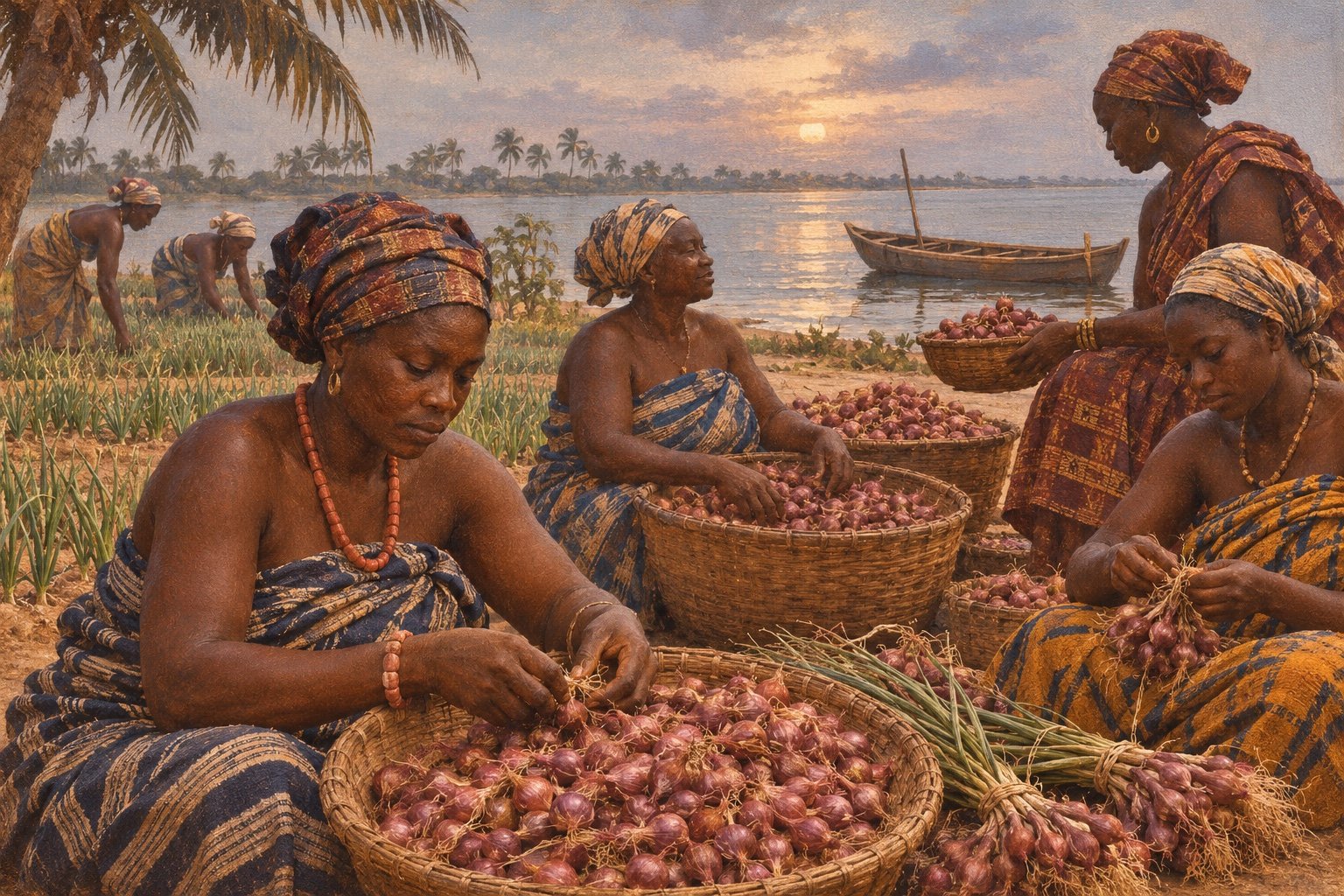
At an Anloga market, a bundle of sabala carries more than a harvest. It reflects years of learning how to farm a narrow, sandy coast, how to manage water in difficult seasons, and how to move a perishable crop from a small bed to buyers across Ghana. The Anlo shallot story is therefore not only agricultural history. It is a history of land-making, skilled labour, women’s commerce and a community turning environmental limits into opportunity.

Farming between the sea and the lagoon
Anlo Ewe communities live on a thin strip of southeastern Ghana between the Atlantic Ocean and the saltwater Keta Lagoon. Researchers who worked in the area describe sandy soils, sparse rainfall, low-lying ground and the recurring risks of drought and flooding. The coast offered fish, salt and routes for exchange, but cultivable land was scarce. Anlo households had long balanced fishing, farming and trade rather than depending on a single occupation. Fish, salt, woven fabrics and mats could be exchanged for vegetables from communities farther north.

In this setting, farmers developed a highly intensive shallot system. They made raised beds in low depressions and marshy areas, shaped ditches to manage water and used shallow wells for irrigation during dry spells. Beds needed regular repair: erosion and flooding could undo earlier work, and Kordylas’s account of Anloga farming in the late 1970s describes people rebuilding beds with sand and plant material. Manure and other locally available soil amendments were part of the system. These were not effortless “reclaimed fields”; each bed represented continuing labour and accumulated knowledge.
When did the shallot industry begin?
Published accounts do not give one uncontested founding date. The difference matters because “first grown,” “grown widely,” and “became a major cash crop” are not the same milestone. A University of Ghana dissertation reviewing earlier work refers to cultivation in the early twentieth century and to a much larger economic shift by the 1930s. Research by Sonia Patten and Godwin Nukunya describes Anloga’s agricultural intensification through fieldwork carried out from 1970 to 1979, while G. K. Nukunya’s 1979 study looks back on roughly half a century of change in southern Anlo.
A later account published by Graphic Online reports an oral recollection from an elderly farmer that Anloga growers began filling marshy depressions for vegetable farms during the 1930s. The same report gives a separate story that shallot bulbs were brought from Agu in Togo by Togbui Dzisam around 1960. These accounts may preserve memories of different stages—the spread of intensive farming, movement of planting stock, or expansion to new plots. They do not establish a single verified inventor or exact date. The careful conclusion is that Anloga’s shallot economy grew through a sequence of local experiments and adaptations, especially during the first half of the twentieth century.
How growers made difficult land productive
The crop’s short growing period helped. J. Maud Kordylas’s description notes that shallots could mature far sooner than sugar cane, allowing farmers to fit several growing periods into a year. That advantage came with close attention to beds, water, pests and soil. Farmers selected shallow land where wells could reach groundwater, raised and drained beds, and watered crops regularly. They replanted and repaired farm surfaces as erosion took its toll. At times, shallots shared beds or seasons with other vegetables, helping households earn income and use scarce space.
This was an evolving system, not a timeless technique unchanged from the beginning. Studies describe adjustments to planting cycles as farmers responded to market demand, rainfall and crop pests. By the 1950s, the system was more intensive than in earlier decades; by the late 1970s, some growers were working additional crop cycles to meet immediate cash needs. Research on agricultural inputs in Anloga also records practical constraints: manure or fertiliser could be costly or unavailable when needed, yields and prices fluctuated, and farmers faced problems such as crop theft and difficulty storing produce. A 2001 University of Ghana study captured conditions during its own survey period; those findings should not be mistaken for a present-day survey.
Women built the market connections
Growing shallots required many hands, but farming and selling were not the same job. Studies of Anloga describe men and women contributing to cultivation and post-harvest work, while women held a particularly strong position in sorting, bundling, buying and selling. They connected growers to traders from other towns and to distant markets. This commercial knowledge included timing, transport costs, relationships with buyers, credit and the challenge of selling a fresh crop before it spoiled.
By the mid-twentieth century, Anloga had become a major shallot market as well as a growing centre. The town’s market followed a four-day cycle. As supplies expanded, market organisation helped manage gluts and avoid overwhelming buyers. Kordylas’s account describes women traders coordinating with market leaders in Accra and Kumasi to receive those traders on alternating market days. That arrangement linked a local crop to wider food networks and responded to a real problem: too many bundles arriving at once could push prices down.
The same account records a wholesale women’s union known as habobboh. Its members bought in bulk from farmers’ wives and sold to outside traders; some also had enough capital to extend credit to visiting buyers. The network brought bargaining power and market knowledge, but it also reveals a tension in the story. Women could carry substantial agricultural and trading responsibilities while facing limits on land access and control of cash-crop fields. Their work shaped the industry even when land ownership and authority were not distributed equally.
A local crop with a national reach
The Anlo shallot story belongs alongside the region’s histories of fishing, salt and lagoon trade. These livelihoods overlapped. Trading fish and salt had long connected coastal households with inland communities; shallot farming added a new crop to that wider exchange. Rather than replacing older occupations, it changed how labour, land and market relationships could be organised.
By the later twentieth century, shallots from the Keta-Anloga area were sold well beyond the coast. Yet the system’s success did not erase the conditions that made it demanding: scarce farmland, sandy soils, seasonal water stress, erosion, transport needs and price swings. The industry was not simply a gift of fertile ground. It was made through repeated labour and practical innovation by farmers, farm workers, household members and women traders.
There is a useful connection here to the story of Afedima of Woe, whose remembered initiative is tied to change in coastal fishing. In both histories, Anlo women appear as economic actors who helped introduce, organise or market new opportunities. Their presence reminds us that Ewe history is made not only in chiefly councils or wartime accounts, but also in fields, landing places, households and markets.
What does sabala mean?
Sabala is the Ewe name used for shallots in Anlo farming and market accounts. The crop is a close relative of the onion, grown for its small bulbs and used as a flavouring in food. In this article, the word also points to a larger history: the farming system and trading relationships that grew around the crop in southern Anlo.
Sources and further reading
- J. Maud Kordylas, “Cash Crop Production in a Coastal Region: The Anlo-Ewe of Ghana,” in Science for Development in Africa (1989), pp. 119–122. Read the chapter PDF.
- Sonia E. Patten and Godwin K. Nukunya, “Organizational Responses to Agricultural Intensification in Anloga, Ghana,” African Studies Review 25, nos. 2–3 (1982), pp. 67–77. View the journal record.
- G. K. Nukunya, “An Endogenous Agricultural Development: The Shallot Industry in Southern Anlo Country,” African Environment 3, nos. 3–4 (1979), pp. 57–67. View the bibliographic record.
- Jonathan Gustav Adomah, A Comparative Study of the Use of Manure and Fertiliser in the Shallot Industry at Anloga in the Volta Region (M.Agric.Admin. dissertation, University of Ghana, 2001). Read the dissertation.
- “Shallot farming in Anloga,” Graphic Online, reporting oral recollections about farming expansion and planting bulbs. Read the report.
Editorial note: Dates of early cultivation vary among scholarly and oral accounts. This article preserves those differences instead of presenting one disputed origin story as settled fact.
Share: