




A language carries more than words. Through Eʋegbe—often written as Ewe in English—people share family histories, songs, proverbs, ceremonies and everyday knowledge across southeastern Ghana, southern Togo and nearby communities in Benin.
A language family, not a single uniform voice
Eʋegbe belongs to the Gbe cluster within the Niger-Congo language family. Speakers use local varieties shaped by place and community. Linguists describe coastal varieties such as Anlo and inland varieties including Ho and Peki; names and boundaries can vary by speaker and context. The existence of a written standard helps people communicate across varieties, while local speech remains part of community identity.


Words that hold knowledge
Eʋegbe is used at home, in markets, churches, schools, music and public life. Oral performance—proverbs, praise poetry, storytelling and song—can carry ethical teaching and local memory. These practices are living and changing: speakers adapt the language to new media and new generations rather than leaving it frozen in the past.
One language across national borders
Present-day borders place many Ewe-speaking communities in different countries, but language ties and family connections continue across them. That does not mean every community has the same history or customs. Local identities matter, and speakers may also use other languages in daily life.
Did you know?
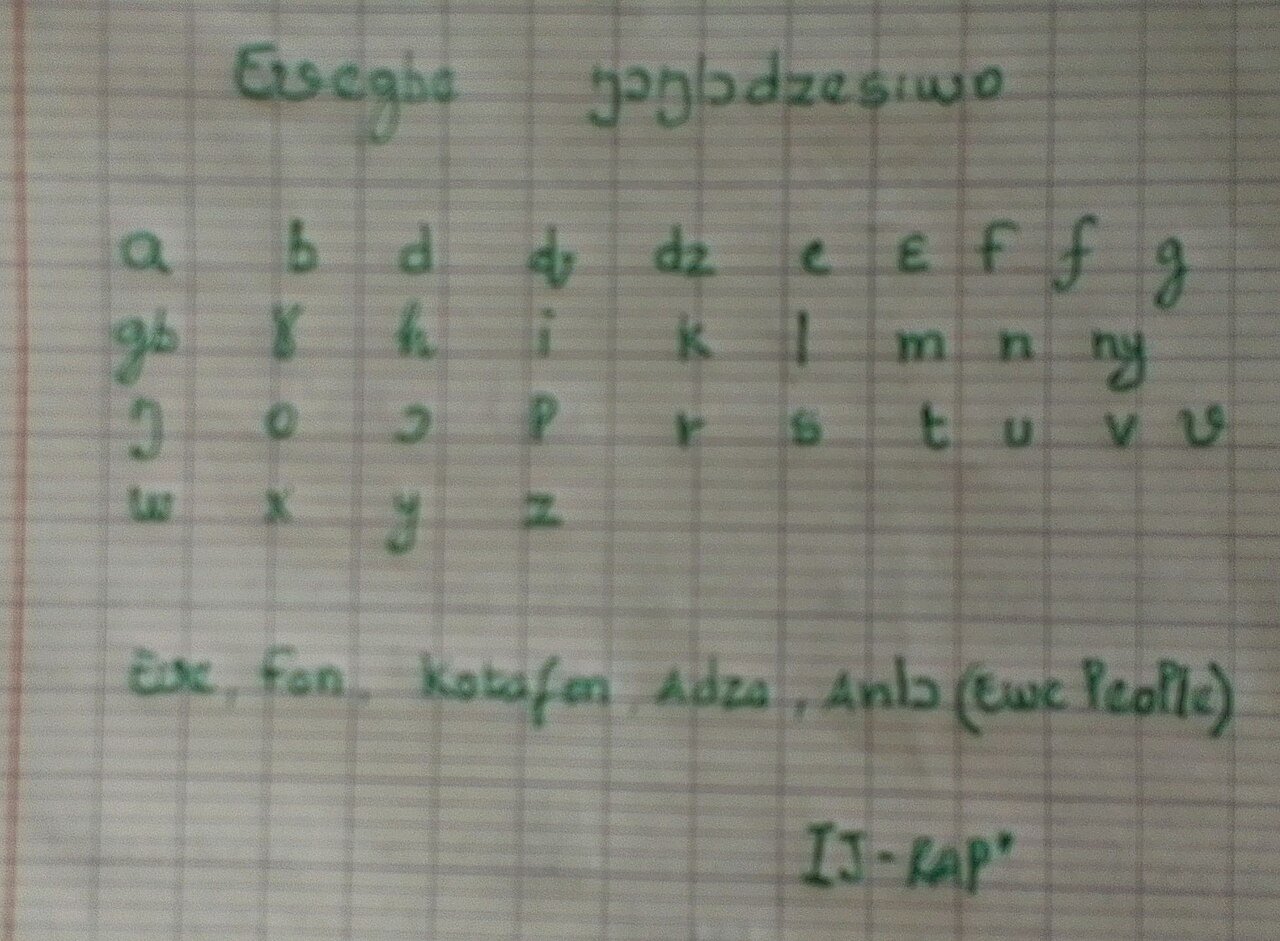
Ewe uses tone: a change in pitch can distinguish words or grammatical meanings. Its writing also includes letters such as ƒ and ʋ, which represent sounds not written with ordinary English letters.
Keep the language growing
Learning a few greetings is a start; listening to fluent speakers, asking about local word choices, and reading aloud help learners notice tone and rhythm. Ewe Pride’s Learn Ewe section can grow into a practical place for lessons, vocabulary and pronunciation resources.
Sources and further reading
Felix K. Ameka and James Essegbey, “Elements of the grammar of space in Ewe,” Cambridge University Press: https://doi.org/10.1017/CBO9780511486753.011
Felix K. Ameka, “Ewe,” Language and Linguistics in Melanesia / CNRS resource: https://lgidf.cnrs.fr/sites/lgidf.cnrs.fr/files/images/Ameka.Ewe.origin%26history.pdf
Share: